When you buy through links on our site , we may earn an affiliate mission . Here ’s how it works .
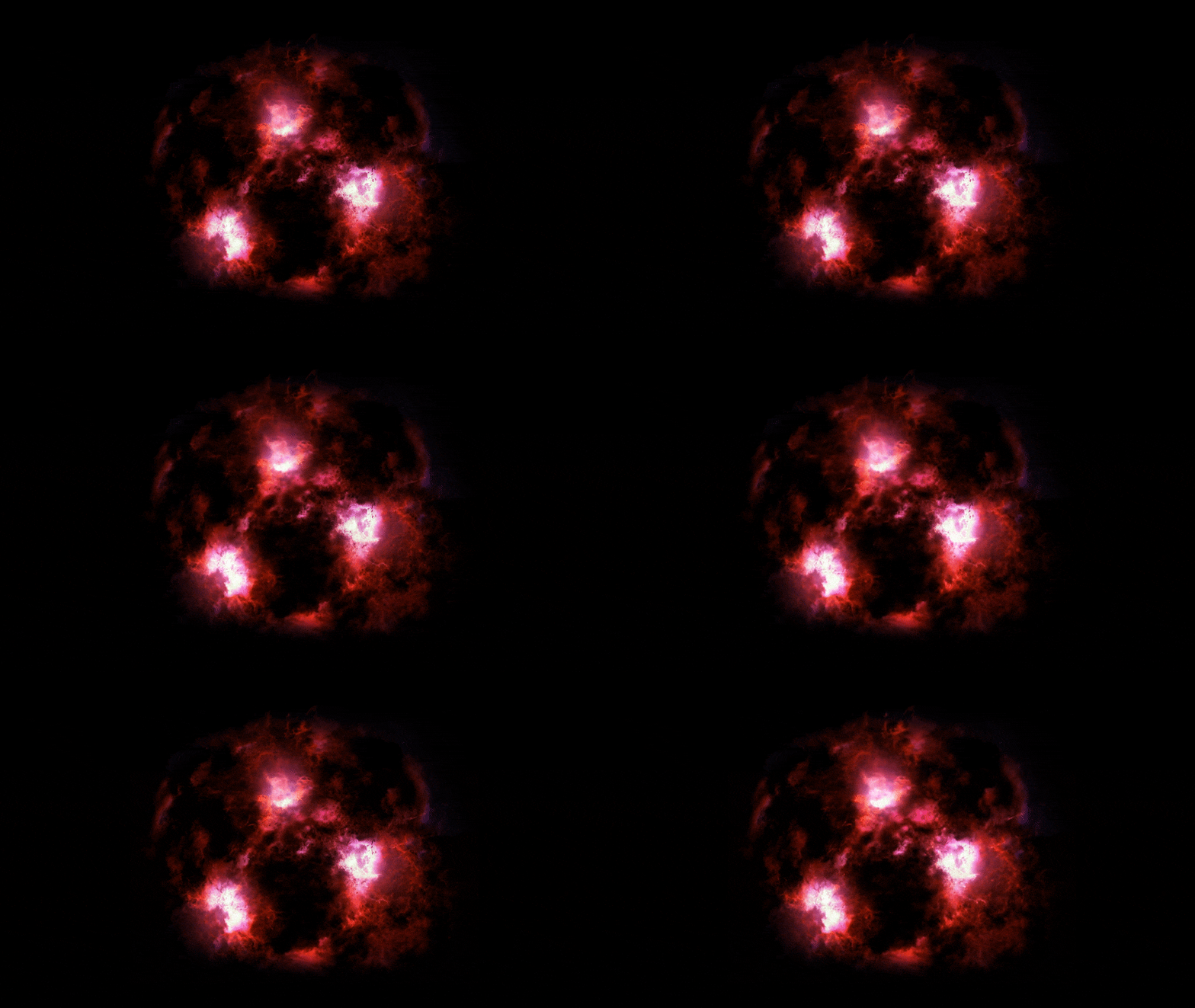
A team of astrophysicists has just spawn 8 million unequalled universes inside a supercomputer and let them germinate from just tots to old geezers . Their goal ? To nail down the purpose that an invisible substance calleddark matterplayed in our universe ’s life since the Big Bang and what it mean for our circumstances .
Afterdiscovering that our universeis mostly write of dark matter in the previous 1960s , scientists have speculated on its role in the organization of galaxies and their power to give parentage to new wiz over time .

According to theBig Bang theory , not long after the universe was born , an inconspicuous and tough sum physicists have dubbed dark-skinned subject start to clump together bythe forcefulness of gravityinto massive cloud called obscure affair halo . As the halo grew in size , they pull in the sparse hydrogen gas riddle the world to come together and form the stars and galaxies we see today . In this hypothesis , dark thing work as the back of galaxies , dictating how they mold , conflate and evolve over time .
link up : The 11 Biggest Unanswered Questions About Dark Matter
To better understand how dark matter shaped this story of the population , Peter Behroozi , an adjunct prof of astronomy at the University of Arizona , and his team create his own universes using the school day ’s supercomputer . The computer ’s 2,000 CPU worked without interruption over a span of three weeks to simulate more than 8 million unique universes . Each universe one by one obey a unique hardening of rules to serve researchers understand the relationship between glowering matter and the development of coltsfoot .

" On the reckoner , we can produce many different creation and liken them to the actual one , and that lets us infer which rules lead to the one we see , " Behroozisaid in a statement .
Whileprevious simulationshave focused on modeling individual galaxies or render mock universe of discourse with special parameters , the UniverseMachine is the first of its scope . The programme continuously produce million of universes , each contain 12 million galaxy , and each allowed to evolve over nearly the intact history of the actual world from 400 million days after the Big Bang to the present day .
" The large inquiry is , ‘ How do beetleweed form ? ’ " tell study research worker Risa Wechsler , a prof of physics and astrophysics at Stanford University . " The really cool matter about this report is that we can employ all the data we have about galaxy phylogeny — the numbers of galaxies , how many star topology they have and how they imprint those star — and put that together into a comprehensive picture of the last 13 billion years of the universe . "

Related : From the Big Bang to Present : Snapshots of Our Universe Through Time
Creating a replica of our population , or even of a extragalactic nebula , would require an inexplicable amount of computing power . So Behroozi and his colleagues narrowed their focus to two key properties of wandflower : their combined mass of stars and the rate at which they give birth to new ace .
" Simulating a individual galaxy requires 10 to the 48th computing operation , " Behroozi explicate , referring to an octillion operation , or a 1 followed by 48 zilch . " All computers on Earth combined could not do this in a hundred years . So to just simulate a exclusive galaxy , let alone 12 million , we had to do this differently . "

As the computer course of study spawns new universes , it makes a guess on how a coltsfoot ’s rate of star formation is related to its age , its past fundamental interaction with other galaxies and the amount of sorry matter in its halo . It then compare each universe with real observation , fine - tuning the forcible parameters with every iteration to better fit reality . The death result is a existence intimately monovular to our own .
concord to Wechsler , their results demo that the charge per unit at which galaxies give parentage to mavin is tightly connect to the mass of their morose topic nimbus . coltsfoot with dark subject halo masses most similar to our ownMilky Wayhad the highest star - constitution rates . She explained that star topology formation is stifled in more monumental galaxies by an abundance of blackholes
Their observance also take exception long - held impression that dingy issue stifled superstar formation in the early universe .

" As we go back earlier and earlier in the world , we would await the obscure issue to be denser , and therefore the gas to be getting hotter and hotter . This is bad for star constitution , so we had think that many galaxies in the early universe should have stop over take form star a long sentence ago , " Behroozi said . " But we bump the opposition : Galaxies of a devote size were more probable to organise stars at a higher rate , adverse to the first moment . "
Now , the squad plan to expand the UniverseMachine to test more ways colored matter might affect the properties of galaxies , including how their shapes develop , the the great unwashed of their mordant hole and how often their whiz gosupernova .
" For me , the most exciting affair is that we now have a example where we can get to ask all of these questions in a framework that sour , " Wechsler said . " We have a model that is cheap enough computationally , that we can essentially calculate an intact population in about a second . Then we can afford to do that millions of times and research all of the parameter place . "

The research group published their results in the September return of the journalMonthly Notices of the Royal Astronomical Society .
Originally publish onLive Science .